



In choosing a design, the investigator should carefully consider the research question, the context of the research, and the nature of the intervention. This figure presents three key questions to guide the selection process among four major design categories: randomized controlled trial (RCT), individually randomized group-treatment (IRGT) trial, parallel group- or cluster-randomized trial (GRT), and stepped-wedge group- or cluster-randomized trial (SW-GRT).
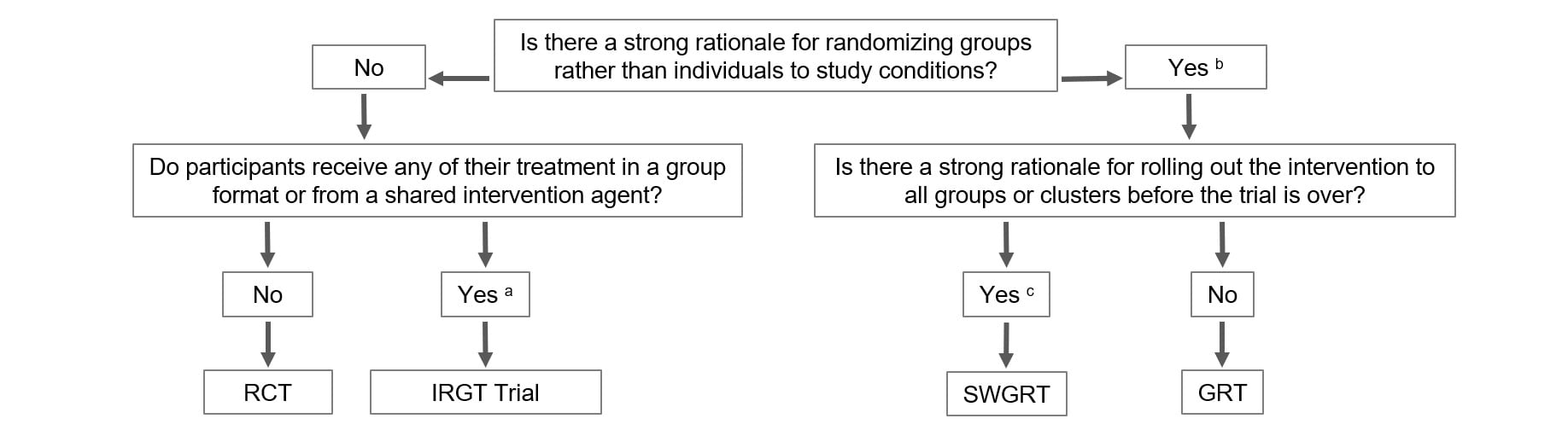
a If any of the intervention is delivered through physical or virtual groups, or through shared intervention agents who each work with multiple participants, positive intraclass correlation can develop over the course of the trial.
b There may be logistical reasons to randomize groups or clusters or it may not be possible to deliver the intervention to individuals without substantial risk of contamination.
c There may be political or logistical reasons to roll out the intervention to all groups or clusters before the trial is over.
Adapted from Murray DM, Taljaard M, Turner EL, George SM. Essential Ingredients and Innovations in the Design and Analysis of Group-Randomized Trials. Annual Review of Public Health. 2020;41:1-19. PMID31869281.
The first question applies to all situations: Is there a strong rationale for randomizing groups or clusters rather than individuals to study arms? Recognizing that the RCT provides the strongest evidence, the Ottawa Statement on the ethical design and conduct of parallel GRTs calls for investigators to provide a clear rationale for choosing randomization of groups or clusters rather than individuals (Taljaard et al., 2013) . Acceptable reasons include the evaluation of a group- or cluster-level intervention; concern about substantial contamination if multiple study arms are implemented in the same group or cluster; the need to reduce costs, enhance compliance, or secure cooperation of investigators; and administrative convenience.
Contamination is often the primary reason for choosing group- or cluster-randomization. Contamination occurs when participants not selected to receive the intervention receive at least some part of it. If the risk of contamination is low, individual randomization is preferred, as an RCT or IRGT will be more efficient than a GRT or SW-GRT. If the risk of contamination is not low, individual randomization is unwise and group- or cluster-randomization is preferred (Campbell et al., 2012; Murray, 1998; Taljaard et al., 2013; Torgerson, 2001).
If there is no strong rationale for group randomization, the next question is: Do participants receive any of their treatment in a group format or from a shared intervention agent? Delivery of the intervention in a group format (in person or virtual), or through intervention agents who each interact with multiple participants in the same arm (in person or virtual), usually leads to correlated outcomes because it creates the opportunity for shared experience, common exposures, or participant interaction. The magnitude of the correlation will depend on the frequency and intensity those experiences, exposures, and interactions. This correlation must be accounted for to avoid a type 1 error (Pals et al., 2008; Roberts & Roberts, 2005) . Correlation of outcomes may arise in one study arm or in multiple study arms.
If there is a strong rationale for randomization of groups, the next question is: Is there a strong rationale for rolling out the intervention to all groups before the end of the trial? There may be political or logistical reasons for an affirmative answer. Nevertheless, given the fact that the SW-GRT confounds time and study arm by design, and usually requires more time and more measurements, the parallel GRT design should be used if possible (Hemming et al., 2015; Hussey & Hughes, 2007; Murray et al., 2010).
Consideration of the three questions in the figure will allow the investigator to select the appropriate design for the research question given the context of the study and the nature of the intervention. It is advisable to assemble a team of both substantive and methodological experts to consider the issues raised here when choosing amongst the four general designs. Once that choice is made, many more decisions will be required on details like the measurement schedule, how participants will be recruited, whether the same participants will be followed over time, the risk of selection bias due to lack of blinding etc. There are a number of excellent texts that provide a more comprehensive description of these issues (Campbell & Walters, 2014; Donner & Klar, 2000; Eldridge & Kerry, 2012; Hayes & Moulton, 2009; Moerbeek & Teerenstra, 2016; Murray, 1998) .